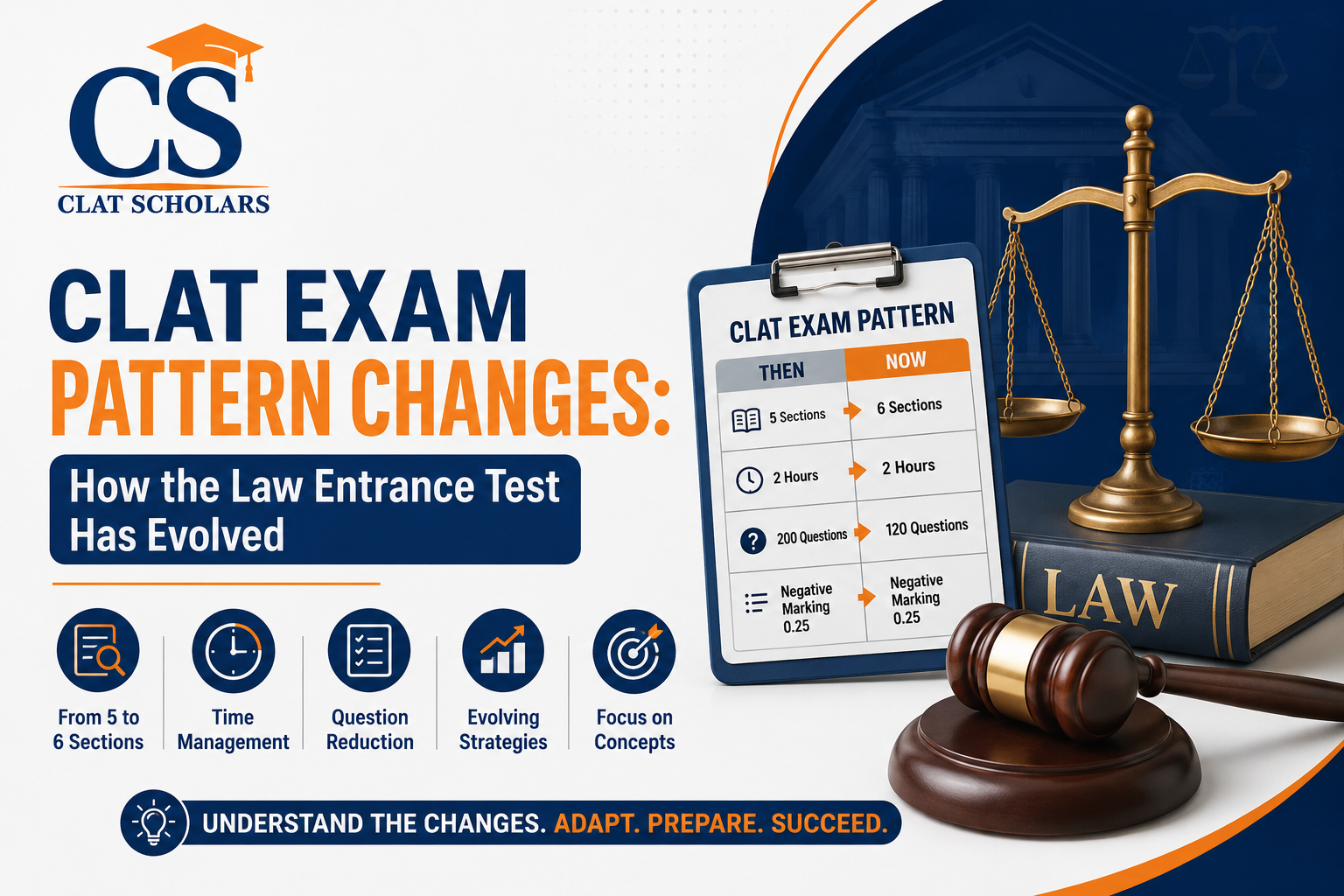
What Is the CLAT Exam Pattern?
The Common Law Admission Test (CLAT) is the national-level entrance examination used for admission to participating National Law Universities (NLUs) in India.
The undergraduate CLAT paper tests candidates across key areas such as:
- English Language
- Current Affairs, including General Knowledge
- Legal Reasoning
- Logical Reasoning
- Quantitative Techniques
A major feature of the modern CLAT pattern is its emphasis on comprehension-based questions. Instead of simply asking candidates to recall isolated facts, many questions require them to understand a passage and use the information provided to reach an answer.
This makes reading ability and reasoning skills central to CLAT preparation.
How Has the CLAT Exam Pattern Evolved?
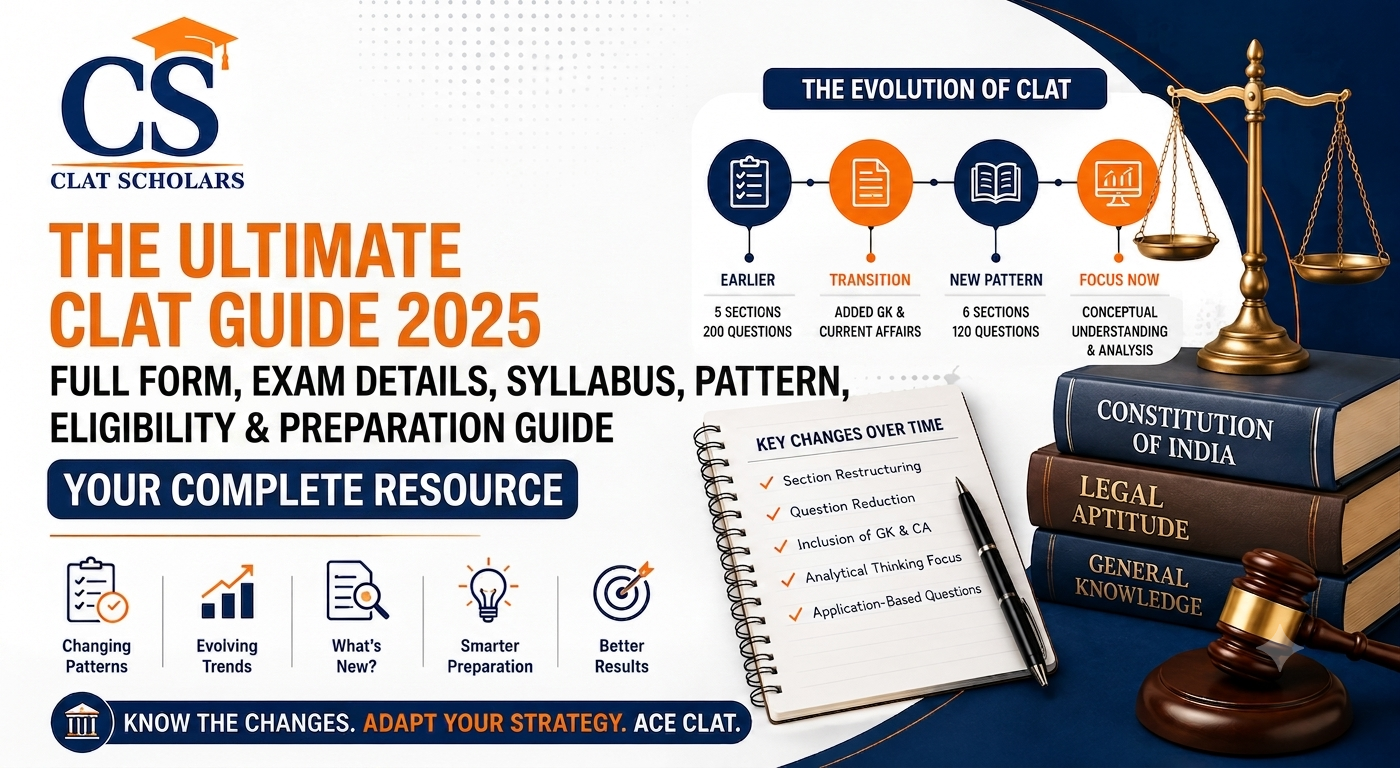
The CLAT examination has undergone several changes in its structure, question design, and emphasis.
Earlier versions of the exam placed greater emphasis on conventional aptitude questions. Over time, the examination moved toward passage-based testing. This shift reflects the skills students need in law school, where reading, interpretation, logical analysis, and applying principles are essential.
The introduction and expansion of passage-based questions made the exam less dependent on memorisation and more focused on comprehension and analytical thinking.
From Direct Questions to Passage-Based Questions
One of the most noticeable changes in the CLAT exam pattern has been the increased use of passages.
For example, rather than asking a standalone question about a legal principle, the exam may provide a passage describing a situation and then ask candidates to identify the principle, apply it, or determine the most appropriate conclusion.
This approach tests whether a candidate can:
- Read information quickly
- Identify relevant facts
- Understand arguments
- Apply principles
- Eliminate incorrect options
Greater Focus on Reading and Reasoning
The modern CLAT pattern rewards students who can process information efficiently.
This is particularly important because several sections require candidates to read passages before answering related questions. Therefore, strong vocabulary alone is not enough. Students also need reading comprehension, critical reasoning, analytical ability, and time-management skills.
Major Changes in the CLAT Exam Pattern
The evolution of CLAT can be understood through a few important developments.
1. Increased Comprehension-Based Testing
Passages now play a central role in several sections. This has changed the way candidates need to prepare.
Instead of studying every topic in isolation, aspirants should practise extracting arguments, facts, assumptions, and conclusions from unfamiliar material.
2. Legal Reasoning Became More Application-Oriented
Legal Reasoning is not simply about memorising legal terms or provisions.
Questions generally require candidates to understand a given principle and apply it to a situation. Basic awareness of legal concepts can help, but the ability to reason from the information presented remains crucial.
3. Current Affairs Became More Relevant
Current Affairs and General Knowledge require consistent preparation. Candidates need to stay aware of important national and international developments, government policies, significant judgments, awards, sports, and other major events.
However, preparation should go beyond memorising headlines. Students should understand the context behind important events.
4. Quantitative Techniques Requires Interpretation
Quantitative Techniques tests basic mathematical ability along with data interpretation.
Candidates may encounter sets involving tables, graphs, percentages, ratios, averages, or other numerical information. The challenge is often to understand the data and solve questions accurately within limited time.
What the Current Pattern Means for Aspirants
The evolution of the CLAT exam pattern has changed the ideal preparation strategy.
A student who spends all their time memorising facts may struggle with the comprehension-heavy nature of the examination. Similarly, someone who only solves questions without building reading speed may find it difficult to complete the paper comfortably.
A balanced strategy is therefore essential.
Build Reading Habits
Read newspapers, reliable news sources, editorials, opinion pieces, and long-form articles regularly.
The objective is not to read everything. Instead, focus on understanding arguments, identifying important information, and becoming comfortable with different writing styles.
Practise Passage-Based Questions
Regular passage practice can improve both accuracy and speed. Start with untimed practice to understand your mistakes. Gradually introduce time limits as your confidence improves.
Take Full-Length Mock Tests
Mock tests help students understand how different sections interact under exam conditions.
After each mock, analyse:
- Questions answered incorrectly
- Questions that consumed too much time
- Topics that caused difficulty
- Questions guessed without sufficient reasoning
The analysis is often more valuable than simply checking the score.
How to Prepare for a Changing CLAT Pattern
Since entrance examinations can evolve, students should avoid depending entirely on old preparation methods.
Follow the latest official examination information, understand the current syllabus and structure, and use recent-quality practice material.
A practical preparation routine can include:
Daily: Reading and current affairs revision
Regularly: Section-wise passage practice
Weekly: Timed sectional tests
Periodically: Full-length CLAT mock tests
After every test: Detailed performance analysis
Most importantly, develop skills rather than preparing only for a fixed question format. Strong comprehension, reasoning, accuracy, and time management remain useful even when individual aspects of the paper change.
Conclusion
The evolution of the CLAT exam pattern shows a clear movement toward testing how candidates understand and apply information rather than simply how much they can memorise.
For aspirants, this means preparation must evolve too. Regular reading, passage practice, reasoning exercises, current affairs revision, quantitative practice, and mock-test analysis can build the skills required for the modern examination.
At CLAT Scholars, the focus should be on helping students understand not only what to study, but also how to approach a changing law entrance examination with greater clarity and confidence.
Frequently Asked Questions
Has the CLAT exam pattern changed over time?
Yes. CLAT has undergone changes in its question structure and emphasis, with the examination increasingly relying on comprehension and application-based questions.
Is CLAT based mainly on memorisation?
No. While current affairs and general knowledge require factual preparation, the examination also strongly tests comprehension, reasoning, interpretation, and application.
Which skills are most important for the modern CLAT?
Reading comprehension, logical reasoning, legal reasoning, current affairs awareness, quantitative ability, accuracy, and time management are all important.
Should students practise previous CLAT papers?
Yes. Previous papers can help aspirants understand question styles, passage structures, difficulty levels, and time-management requirements. They should, however, be combined with preparation based on the latest official pattern.
Admin
Faculty at CLAT Scholars
 WhatsApp