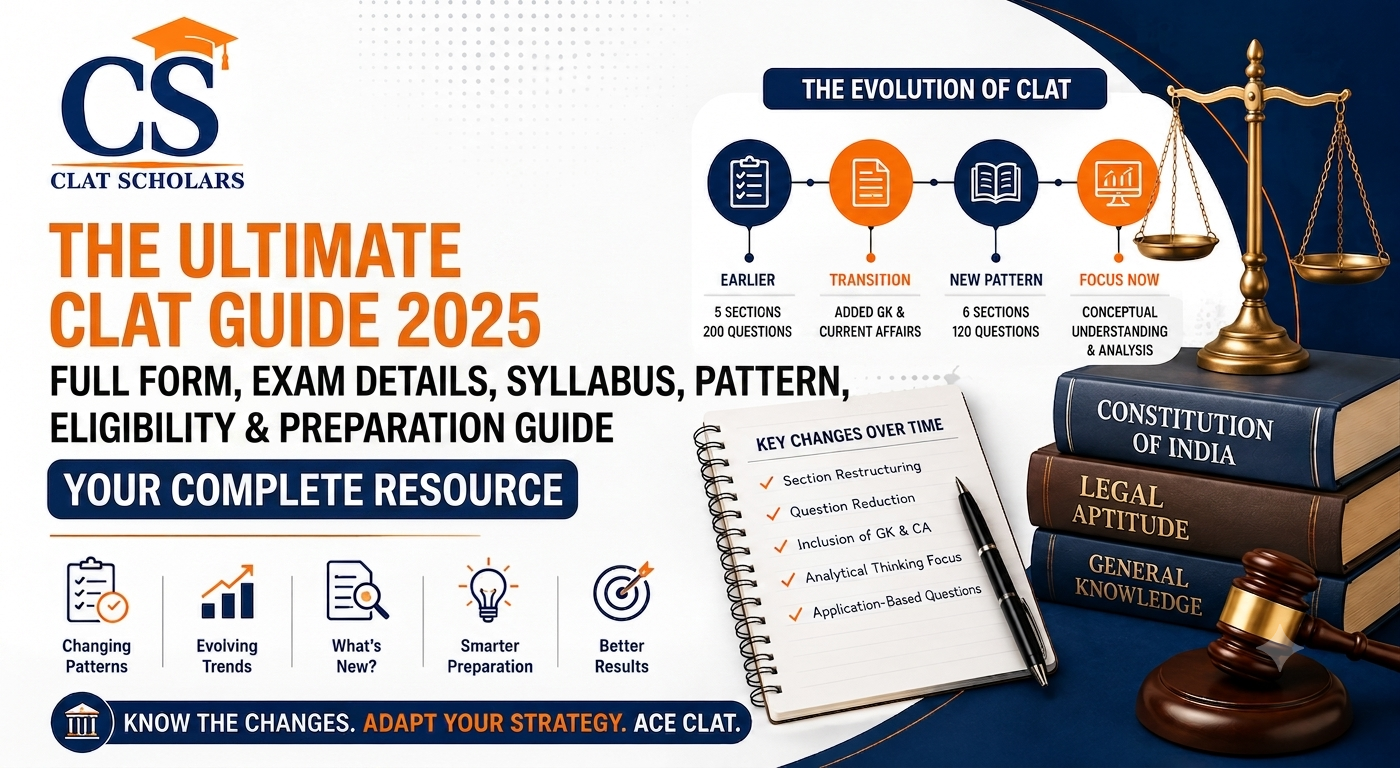
What Is the CLAT Full Form?
CLAT stands for Common Law Admission Test. It is primarily used for admission to undergraduate and postgraduate law programmes offered by participating NLUs.
For undergraduate aspirants, CLAT generally assesses skills such as reading comprehension, logical reasoning, legal reasoning, quantitative techniques, and current affairs. The exam is designed to test skills that are useful for studying law rather than simply checking memorised information.
What Is the CLAT Exam?
CLAT is a competitive law entrance examination for students seeking admission to undergraduate law programmes after Class 12 and postgraduate law programmes after completing an eligible law degree.
The CLAT UG exam focuses heavily on comprehension, reasoning, general awareness, and analytical ability. Because the examination is competitive, candidates need both conceptual understanding and regular practice.
The exam is conducted under the administration of the Consortium of National Law Universities, which publishes official notifications, application details, and examination-related information.
Important: Candidates should always check the latest official notification for the applicable examination year because the exam pattern, dates, eligibility rules, and participating institutions can change.
CLAT Eligibility Criteria
CLAT UG Eligibility
Candidates appearing for CLAT UG generally need to have passed or be appearing in their Class 12 or equivalent examination from a recognised board.
The eligibility requirements may include minimum qualifying marks, and the applicable criteria can vary according to the official notification for the relevant year.
There is generally no upper age limit for appearing in CLAT UG, subject to the rules specified by the Consortium.
CLAT PG Eligibility
CLAT PG is intended for candidates seeking admission to postgraduate law programmes. Applicants generally need a qualifying undergraduate law degree from a recognised institution.
Since eligibility conditions can be updated, candidates should verify the exact requirements before applying.
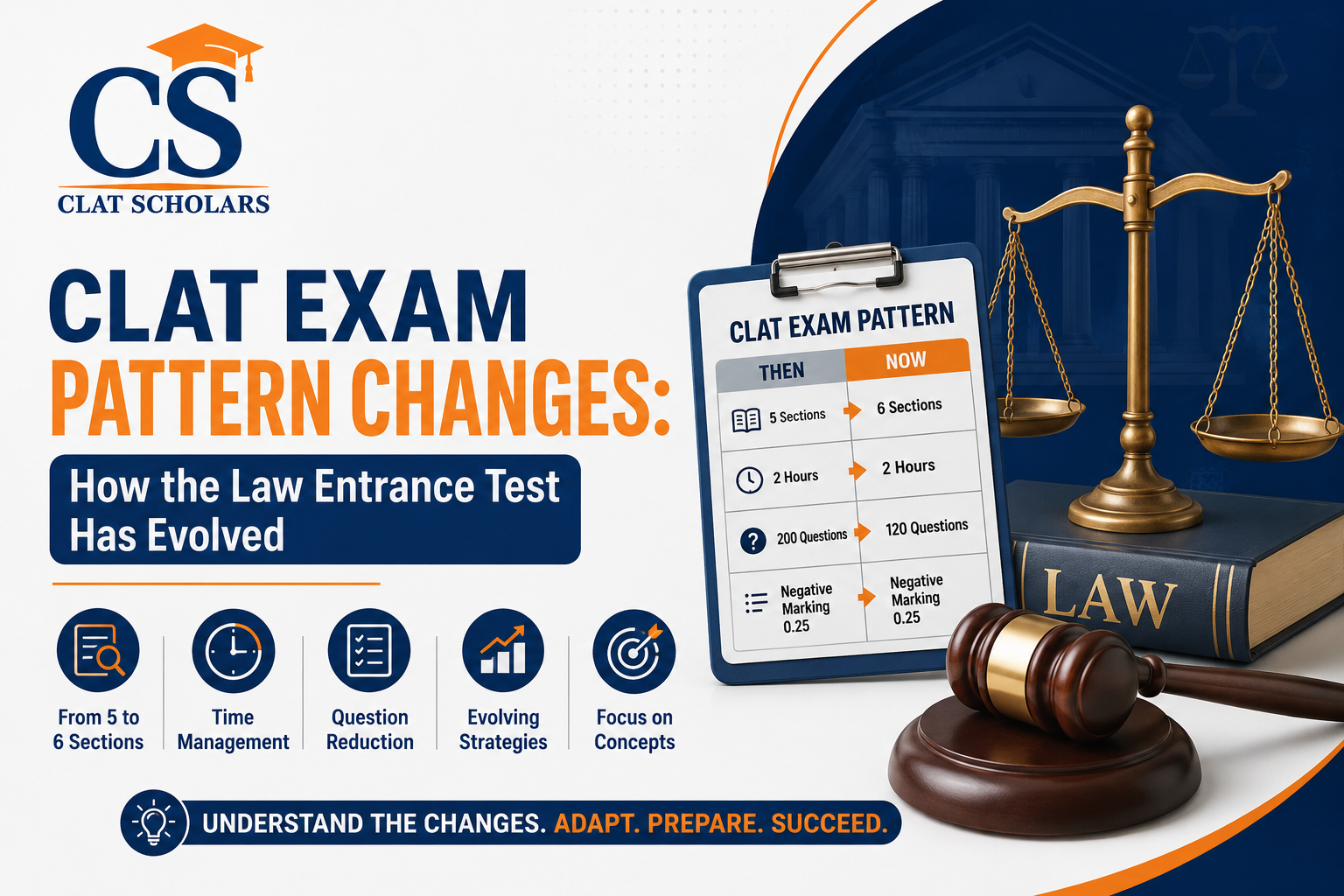
CLAT Exam Pattern
Understanding the CLAT exam pattern helps students organise their preparation and practise according to the actual structure of the examination.
For CLAT UG, questions are presented through passages followed by multiple-choice questions. The major areas tested include:
Section
What It Tests
English Language
Reading comprehension, vocabulary and language skills
Current Affairs & General Knowledge
National and international events, general awareness
Legal Reasoning
Legal principles, passages and application of reasoning
Logical Reasoning
Arguments, conclusions, assumptions and analytical reasoning
Quantitative Techniques
Basic mathematical concepts and data interpretation
The paper is designed to test how effectively candidates can understand information and apply reasoning within a limited time.
Why Time Management Matters
CLAT preparation is not only about solving questions correctly. Speed also matters. A student may understand a passage but still lose marks if too much time is spent on one difficult question.
Timed sectional tests and full-length mock tests can help candidates improve both accuracy and decision-making.
CLAT Syllabus
The CLAT syllabus is primarily skill-oriented. Instead of relying only on textbook memorisation, candidates should develop strong reading and reasoning abilities.
English Language
Preparation generally involves:
- Reading comprehension
- Vocabulary in context
- Main ideas and supporting details
- Inference-based questions
- Tone and purpose of passages
Current Affairs and General Knowledge
This section requires consistent awareness of important developments. Students should follow major national and international events, government initiatives, awards, sports, science, economics, and significant legal developments.
Legal Reasoning
Legal reasoning usually involves reading passages based on legal principles or situations and applying the information provided. Strong reading comprehension is particularly useful here.
Logical Reasoning
Important areas include arguments, assumptions, conclusions, relationships, inferences, and analytical reasoning.
Quantitative Techniques
Candidates should build confidence in fundamental mathematical concepts and practise interpreting numerical information, tables, graphs, and data-based questions.
How to Prepare for CLAT
A practical CLAT preparation strategy should combine concept building, reading, question practice, revision, and mock tests.
1. Build a Consistent Reading Habit
Read quality newspapers, editorials, magazines, and reliable current-affairs sources. Focus on understanding arguments rather than merely collecting facts.
2. Strengthen Your Fundamentals
Identify weaker areas in mathematics, reasoning, vocabulary, or comprehension and work on them systematically.
3. Practise Passage-Based Questions
Since CLAT relies substantially on passages, practise reading quickly while identifying the central argument, relevant facts, and logical connections.
4. Take Mock Tests Regularly
Start with sectional tests and gradually move to complete mocks. After every test, analyse incorrect answers and questions that consumed excessive time.
5. Maintain a Revision System
Keep concise notes for current affairs, important concepts, formulas, and recurring mistakes. Regular revision is more effective than trying to study everything immediately before the examination.
Final Takeaway
Knowing the CLAT full form is only the beginning. A strong preparation plan requires a clear understanding of the exam pattern, syllabus, eligibility criteria, and the skills tested.
Focus on reading every day, practise passage-based questions, stay updated with current affairs, analyse mock tests, and improve your weaker areas consistently. With a structured approach, CLAT preparation becomes more manageable and measurable.
For the latest examination dates, eligibility rules, application process, and official updates, always refer to the current notification issued by the CLAT authorities.
Admin
Faculty at CLAT Scholars
 WhatsApp